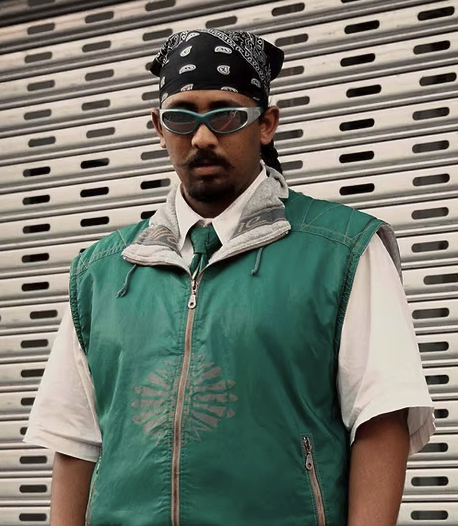

Shakeel Toefy is a Cape Town-based filmmaker, photographer and creative entrepreneur, and the co-founder and Managing Director of Half & Halve, a multidisciplinary production house working across film, fashion, music and art.
Combining a strong creative instinct with an analytical approach to production, Toefy’s work is shaped by human connection, identity and the beauty found in individual experience. Through Half & Halve, he is committed to creating opportunities for creatives of colour and challenging conventional ideas of representation within South Africa’s creative industries.
In 2025, Half & Halve presented its debut exhibition, Klop Klop – Identity: A Brightly Coloured Archive, bringing together original artworks and documentary filmmaking to explore Coloured South African identity, heritage, community and cultural memory.
Driven by ambition and a belief in the power of creative expression, Toefy continues to use filmmaking and visual storytelling to provoke emotion, celebrate identity and show young creatives that ambitious careers in the arts are possible.
What was the starting point for this film, and what made you want to tell this particular story?
The film began with us reflecting on our own creative lives and what it means to inherit a cultural and creative history while working in the industry today. In our family, our grandfather, and later our father, became the keepers of our family history through photographs and extensive research into our lineage.
This instinct to archive, alongside a desire to explore the joy and creativity within our heritage, naturally led us to the Kaapse Klopse, a powerful expression of creativity, community and legacy for many Coloured people.
We also have personal connections to the Klopse through family trips to watch the performances, as well as our aunt, cousins and extended family who were involved with a troupe for many years. What began as an exhibition grew into a short-form documentary and has since developed into Klop Klop as an ongoing exploration of heritage and creativity.
What did the short-film format allow you to do creatively that a longer format might not have?
The short format allowed us to create a documentary that exists within the world it explores, while leaving room for the film and the conversation around it to continue evolving.
Rather than attempting to tell the complete story of the Klopse, the short form gave us a starting point that sparks curiosity and invites audiences to explore further. It also allows us to continue developing the project alongside the conversations, perspectives and collaborations that emerge from it, rather than presenting a fixed or complete narrative.
Is there a particular moment, character or idea in the film that holds special significance for you as the director?There is a moment when one of the troupe members we interviewed, Riyaaz Omar, speaks about his love for the Klopse. He says, “Not the competition, the love.”
This holds particular significance for us because, beneath everything the Klopse has become today — the competition, spectacle, sponsorships and commercialisation — there is still a deep love at its core. The people who participate do it because of their love for their community, families, culture, performance and creativity.
For us, that is what the Klopse ultimately represents: love and joy.
What conversation do you hope the film creates with audiences after they leave the cinema?
We hope Klop Klop leaves audiences with a deeper understanding of the Kaapse Klopse as an ever-evolving and joyful cultural practice that is central not only to Cape Town’s cultural ecosystem, but, importantly, to the lives of the many people who sustain it and whose voices and contributions often go unseen.
We want audiences to question how traditions are preserved, represented and understood, particularly when they emerge from communities historically marginalised within South Africa’s cultural narrative. We hope audiences consider who gets to shape cultural narratives, whose histories are preserved and what is lost when living traditions are reduced solely to the pain and trauma of their history.
Ultimately, we hope Klop Klop creates conversations around cultural ownership, visibility, place and belonging, while recognising the Klopse as a dynamic, contemporary creative and cultural practice rather than simply an artefact of the past.
Where does this film sit within your wider creative journey, and what are you interested in exploring next as filmmakers?
Moving forward, we intend to expand Klop Klop into a feature-length film, deepening its focus on the Kaapse Klopse as an ever-evolving cultural institution. We are particularly interested in exploring its relationship with histories of land, displacement, identity and collective memory, while positioning the Klopse as a living creative tradition that continues to foster artistic practice within the community.
The next phase will also examine the Klopse as a contemporary cultural form shaped by internal and external pressures, including increasing commercialisation, the framing of the tradition within competitive and sporting structures, and ongoing questions around visibility, access and spatial belonging in the modern city.
Collaboration and community are central to both of our practices as filmmakers. Through Klop Klop, we want to engage with artists, scholars, practitioners and members of the local community, allowing the project to develop through multiple perspectives rather than imposing a singular narrative.
We are interested in building a tapestry of archival works across film, photography, writing and oral histories that captures the nuance and complexity of the Klopse at this pivotal moment. This reflects the filmmakers we want to become: using collaborative and archival practices to document communities in ways that are participatory, nuanced and responsive to the present.