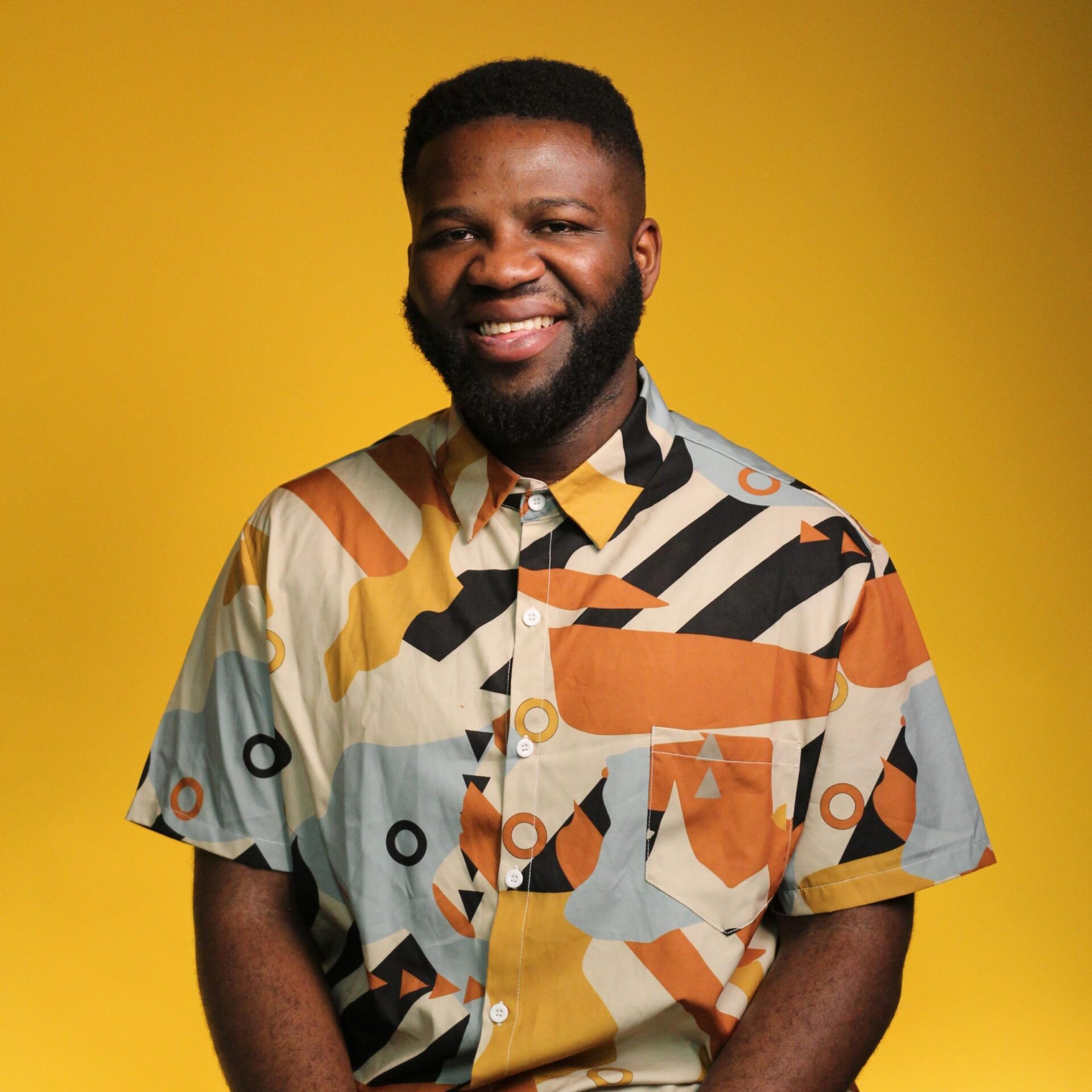

Kiosa Sukami is an award-winning British-Congolese filmmaker recognised for his distinctive approach to cinematic realism and his ability to tell powerful, socially resonant stories.
His acclaimed short film, A Letter to Black Men, was longlisted for Best British Short at the 25th British Independent Film Awards, nominated for Best Short at Raindance 2022 and Best British/Irish Short at the 43rd London Critics’ Circle Film Awards. The film won Best UK Short at the 2022 Manchester Film Festival and was later adapted into a five-part limited web series in 2026.
Born in Kinshasa, Democratic Republic of Congo, Sukami discovered his passion for filmmaking after his family sought asylum in the UK during the Second Congo War. He went on to train at Bournemouth Film School before gaining industry experience working in-house at several production companies and ultimately pursuing directing full-time.
Sukami is currently developing his debut feature film while continuing to write for television and digital platforms.
What was the starting point for this film, and what made you want to tell this particular story?
The starting point was discovering how little I actually knew about Zaïre’s (DR Congo) journey to the 1974 World Cup. Growing up Congolese, I knew the images and infamous scorelines, but the deeper I researched, the more I realised there was an extraordinary human story behind what the world remembers. These players arrived in West Germany as champions of Africa and pioneers — the first team from Sub-Saharan Africa to qualify for a World Cup. Yet their story has often been reduced to their defeats rather than what they achieved or endured. I wanted to look beyond the statistics and reclaim that history from a Congolese perspective. For me, it became a story about football, but also about power, dignity, national identity and what happens when young men are asked to carry the expectations of an entire country.
What did the short-film format allow you to do creatively that a longer format might not have?
The short-film format forced us to be very precise. Rather than attempting to explain the entire history of Zaïre (DR Congo) at the 1974 World Cup, we could capture a particular feeling and introduce audiences to this world through key moments. It allowed me to approach the film as a window into a much larger story, focusing on atmosphere, performance and visual storytelling while leaving certain questions unanswered and encouraging audiences to want to know more. In many ways, the short is a proof of concept for the feature film we are developing. The challenge was to create something that feels complete while suggesting a much bigger world beyond those ten minutes.
Is there a particular moment, character or idea in the film that holds special significance for you as the director?
Ndaye Mulamba holds particular significance for me. He entered the 1974 World Cup as one of Africa’s most exciting footballers, having been the top scorer as Zaïre (DR Congo) won the Africa Cup of Nations. Yet his story and achievements are not as widely recognised internationally as they should be. What interests me is the contrast between the public image of a national hero and the human being carrying that responsibility. Through Mulamba, I was able to explore the pressure placed on these young men, who were simultaneously footballers, national symbols and representatives of a political project much larger than themselves. That tension between personal ambition and the burden of representing a nation sits at the heart of the film for me.
What conversation do you hope the film creates with audiences after they leave the cinema?
I hope audiences leave questioning the version of history they have inherited. For decades, DR Congo’s appearance at the 1974 World Cup has often been remembered through humiliation, particularly the 9–0 defeat against Yugoslavia and the famous free-kick incident against Brazil. But there is a much more complicated human and political story behind those images. I hope the film encourages audiences to ask: Who gets to tell history, and what gets lost when we reduce people to a single moment? Above all, I want Congolese and African audiences to see these players not simply through the way the world remembered them, but as pioneers who reached a stage no Sub-Saharan African team had reached before them.
Where does this film sit within your wider creative journey, and what are you interested in exploring next as a filmmaker?
Leopard of Congo feels like an important evolution in my work. I have always been interested in identity, masculinity, belonging and the experiences of Black men, but this film has allowed me to connect those themes more directly with my Congolese heritage and African history. Having been born in Kinshasa and raised in the UK, I am particularly interested in stories that exist between those worlds — stories that can be culturally specific while still speaking to universal human experiences. The next step is to expand Leopard of Congo into the feature film we are currently developing. The short only opens the door to this history; there is a much larger story to tell about these players, the political environment surrounding them and what happened when Africa arrived on football’s biggest stage. More broadly, I want to continue making ambitious, cinematic stories that place African and diasporic characters at their centre — not as supporting characters in someone else’s history, but as the authors of their own.